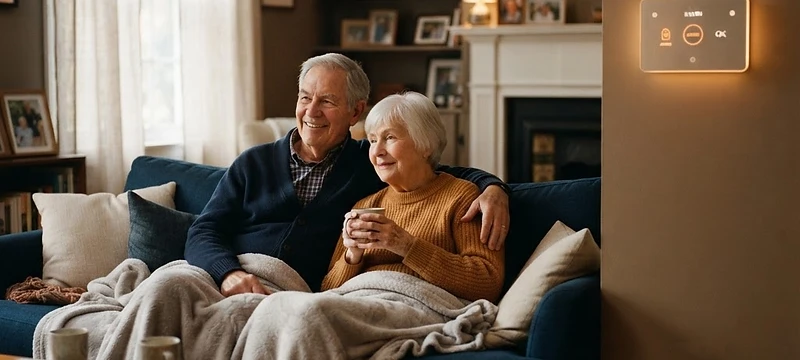
Home Security for Aging Parents: A Guide for Adult Children
Most parents want to stay in their own home. Here's how to make that safe and independent, without making them feel watched.
If you're an adult child worrying about a parent living alone, you're in a large and growing group. Most older adults want to age in their own home — and with the right setup, they safely can.
Here's how to think about it.
Start with the real risks
It's not just burglary. For an older adult living alone, the risk profile looks different:
- Falls — the leading cause of injury among older adults, and often the inability to call for help afterward
- Medical events — stroke, cardiac events, diabetic emergencies where minutes matter
- Scams and door-to-door predators — older adults are targeted deliberately
- Break-ins — living alone, sometimes visibly, makes a home a target
- Fire and carbon monoxide — slower reaction time makes early warning critical
A security plan for a parent should address all of these, not just intruders.
The independence conversation
Here's the part that matters most, and the part people get wrong. Most parents don't resist security out of stubbornness — they resist feeling surveilled and feeling diminished. The framing changes everything.
Don't say: "I need to keep an eye on you." Do say: "I want you to be able to stay in your home, and this makes that safer for both of us."
Position it as protecting their independence, not supervising them. Lead with the benefits they care about: staying in their own home, not moving in with anyone, not needing a facility.
What to actually install
Door and window sensors. Straightforward perimeter protection. They also catch a door left open — a real risk.
A doorbell camera. Helps screen who's at the door before opening it. A genuine defense against scammers and distraction burglaries, which specifically target older adults.
Smoke and carbon monoxide detectors tied into monitoring. This is the one people most often skip and most need. A standalone alarm beeps. A monitored detector alerts a monitoring center that dispatches the fire department — even if your parent is asleep or can't get to a phone.
A medical alert or panic button. Worn on a wrist or pendant, or placed on a nightstand. If your parent falls and can't reach a phone, one button calls for help.
Cellular backup. Non-negotiable here. The system must work if the phone line is cut or the internet drops.
24/7 professional monitoring. For an older adult living alone, this is the core of the whole plan. Someone is watching the sensors around the clock and will dispatch emergency services — whether or not you're available to answer your phone.
Set up the contact list properly
Make sure your parent's monitoring account has an accurate contact list:
- Your parent first
- You and any siblings, in priority order
- A nearby neighbor or friend who has a key
Update it whenever anything changes. Outdated contacts delay response.
Share access without hovering
Most modern systems let you check in through an app — arm status, camera view, recent activity. Used well, this is reassurance for you and independence for them.
A few guidelines:
- Tell them you have access. Never install monitoring they don't know about.
- Don't narrate their day. Checking in constantly damages trust.
- Let them keep control. They should arm and disarm their own system.
- Use alerts for exceptions, not surveillance. "Tell me if the alarm goes off" — not "tell me every time you leave."
Make the physical environment safer too
Security tech doesn't fix a fall risk. Pair it with basic changes:
- Grab bars in the bathroom
- Night lights along the path from bed to bathroom
- Remove loose rugs and clear trip hazards
- Bright exterior lighting at every entry
- A second handrail on stairs
Splitting the cost with siblings
If you have siblings, agree early on who pays and how. The cleanest approach: one person owns the account, everyone contributes the monthly, and all siblings are on the emergency contact list.
The bottom line
A monitored security system lets an aging parent stay in their own home longer, with faster help when something goes wrong — and it gives you genuine peace of mind instead of constant low-grade worry.
Frame it as independence, include medical and fire protection, not just burglary — and remember that the $1,200 free equipment offer means the equipment cost isn't a barrier. Claim a kit for your parent and set the contact list up carefully.